
RED-S: Energy Deficiency in Young Athletes
Today I'm writing about a topic that doesn't get talked about much: energy availability in young athletes, and specifically, energy deficiency.
The reason I'm writing this is our family's own experience and the lack of information out there, since awareness of this condition is still fairly new.
This is about RED-S (Relative Energy Deficiency in Sport), which means relative energy deficiency in athletes. REDs is a syndrome that impairs athletes' health and performance. It develops over a longer period of time, when more energy is burned through exercise than is taken in through food. This energy deficiency disrupts the body's normal functions and can affect anyone who is physically active.

The Long Road to Answers
For us, this started to show when my daughter began competitive gymnastics, training 10.5 hours a week. I noticed something was off when she suddenly fit back into pants that had gotten too small for her, and she told me she'd lost ten pounds. It happened to be time for her annual check-up, so I mentioned to the doctor that she'd lost this much weight and that her period was already more than a year late. (She'd had it twice at age 13, so it had officially started.) The doctor said the weight loss was normal, given how much she does gymnastics. I explained that she ate healthy to heal her acne and had cut out sugar, wheat flour, oats, rice, and pasta, as well as dairy, and the doctor confirmed that she was eating well. I asked whether she should still be eating carbohydrates given how much she trained, but since she was eating a lot of quinoa and vegetables, there didn't seem to be any reason to change anything.
The doctor was concerned about the missed periods, though. First she ordered blood tests, which checked things like hormone levels. Nothing alarming turned up, so next came an ultrasound. Only once this test also showed nothing wrong, and that her body was normal, did the doctor refer us to a gynecologist.
The Diagnosis: RED-S
The gynecologist visit was a consultation, where we talked about my daughter's eating and activity level. This doctor listened and asked a lot of questions, and finally told my daughter that she was moving more than she was eating, and that as a grown man, he couldn't imagine doing 10.5 hours of exercise a week himself, even though he ate far more calories than she did. The doctor's diagnosis was that she had an energy deficiency typical among athletes, known as RED-S. This was completely new to us, and we felt relieved to finally know what was wrong. The diagnosis wasn't scary, but it was eye-opening. I had never heard of RED-S before. The doctor explained that RED-S falls under the same umbrella as eating disorders, even though it isn't a typical eating disorder itself. That stopped me in my tracks. "Eating disorder" only brought to mind people I'd known growing up who developed anorexia nervosa or bulimia. My daughter wasn't starving herself to lose weight. She wanted to eat healthy, and I had even encouraged her in that. I just hadn't realized she had an energy deficiency. Energy deficiency! It was that simple. Finally, everything clicked into place.
Recovery and Looking Ahead
The doctor sent us for a DEXA scan, to measure her bone density and check for osteoporosis, and we also got a referral to a nutrition therapist. The nutrition therapist noted that my daughter already knew about healthy eating as much as he did.
The doctor was especially concerned about her bone density, since she'd fractured her elbow at the start of fall, right before the competition season began. Osteoporosis is one of the major health risks for those with RED-S. As it turned out, her bone density wasn't outside the normal range, though the doctor had expected it to be higher given how much she trains.
My daughter was put on a break from any activity outside of school and gymnastics, and she needed to start eating a lot more to get enough energy. She began eating the same dinners as the rest of us, so pasta, rice, and bread were back on the menu. She also needed to eat energy-dense snacks before and between training sessions. We made things like energy balls with dates and nuts. Her strength came back, and she wasn't tired anymore. She had more energy for both school and gymnastics. Her hormone levels improved, and her weight went up quickly at first before leveling off to normal. She got her period back after a two-year gap. That milestone also meant she was cleared to move freely again. She also noticed a big change in her body temperature. She used to always run hot, but over the past year she had been cold more often, like me, and wearing extra layers. Now she was back to herself, running hot rather than cold, like her father. Now she looks like a strong, athletic young woman, and we're hoping her cycle settles into a normal rhythm and that the next competition season goes more smoothly now that she has the strength and energy for it.
All of this brought us a lot of extra worry throughout her entire 9th grade year, and I wish I'd known more about this topic so we wouldn't have had to go through it. She had to go through far too many tests before we ever got this diagnosis.
Food That Keeps You Going
It's good to be aware that a young athlete who trains a lot has different muscle mass and energy needs than an average teenager. There's a lot of talk these days about healthy snacks, but it's often overlooked that someone who exercises a lot needs more energy, and especially carbohydrates the body can use quickly. So snacks for these young athletes often need to look quite different.
This summer her gymnastics gym held a webinar on athletes' energy needs, and I'm glad that younger kids might be spared this experience, as they're being guided to eat enough from the start.
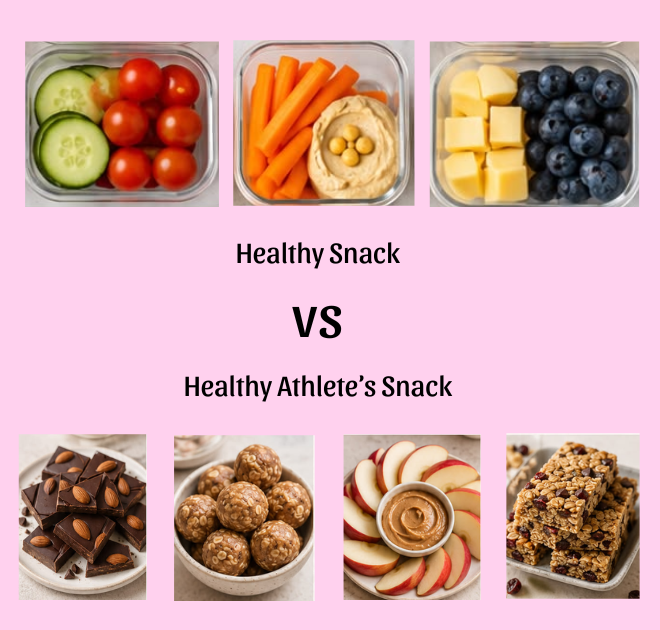
Good snacks for athletes during practice should include carbohydrates that the body can use quickly, like pretzels, crackers, and fruit. These snacks should be low in fiber. Fiber takes longer to digest, so it's not ideal when the body needs energy fast.
Orthorexia, Energy Deficiency, and RED-S
One thing that surprised me while researching this topic: RED-S doesn't require a diagnosed eating disorder behind it. You can end up there through completely ordinary, well-intentioned eating.
A helpful article from MEDA breaks down three related concepts that help explain how this happens.
Orthorexia refers to an obsessive pursuit of "clean" eating, where more and more foods get cut from the diet.
LEA (Low Energy Availability) means the body isn't getting enough energy for both training and normal functions, like hormone production and bone health.
RED-S is a condition that can follow when this continues for a long time and the body starts shutting down "non-essential" functions to protect the most important ones.
These three are often connected, and the line between them can be blurry: eating too strictly can gradually turn into low energy availability, and eventually into RED-S.
That's exactly what happened to us. Our daughter started eating "clean" to help clear up her acne, not to lose weight. But between cutting out so many foods and how much she was training, she just wasn't getting enough energy.

RED-S Facts
Symptoms of RED-S:
Persistent fatigue and low energy
Decline in athletic performance and strength
Recurring injuries, such as stress fractures
Irregular or missing periods, low estrogen
Low testosterone or low libido in men
Weakened immunity and frequent illness
Health risks of RED-S:
Bone thinning (osteoporosis)
Low heart rate and low blood pressure
Delayed growth and development in teens
Mood changes, such as depression and anxiety
If you recognize these symptoms in your own child, don't sit with it alone. Reach out to a doctor and share your concerns directly, especially if periods are late or absent, or if your child keeps getting overuse injuries. In our experience, it pays to be persistent and ask for a referral to a specialist if you feel like your concerns aren't being taken seriously. As a parent, you know your child best.
For more information, check out these pages:
I hope this post helps someone, and that this is a topic we can talk about more openly. Feel free to comment below if this is something your family has experienced too.

← Back to: Home
